mineral gallery

If you wish to view any of the images full size, click on the thumbnails.


The images displayed in this first series were scanned from the collection available as posters or postcards from the M.A.C.

Amethyst/Améthyste

Location: Thunder Bay, Ontario, Canada
Source: Royal Ontario Museum/Musée Royal de l'Ontario
Notes: This variety of quartz is the official mineral emblem of Ontario./Cette varieté de quartz est l'emblème minéral de l'Ontario.
Photography: Calvin Nicholls, reproduced courtesy of Nicholls Design, Inc.


Cubanite crystals/Cristaux de cubanite

Location: Henderson Mine, Chibougamau, Québec
Source: Canadian Museum of Nature/Musée Canadien de la Nature
Photography: Jeffrey A. Scovil, reproduced courtesy of Canadian Museum of Nature
Photographie: Jeffrey A. Scovil, courtoisie Musée Canadien de la Nature


Diopside on grossular/Diopside sur grossulaire

Location: Jeffrey Mine, Asbestos, Québec
Notes: This asbestos mine, exploited for more than 100 years, is a world famous mineral locality./Cette mine d'amiante, exploitée depuis plus de 100 ans, est une localité minéralogique reconnue mondialement.
Source: Canadian Museum of Nature/Musée Canadien de la Nature
Photography: Jeffrey A. Scovil, reproduced courtesy of Canadian Museum of Nature
Photographie: Jeffrey A. Scovil, courtoisie Musée Canadien de la Nature


Gypsum/Gypse

Location: Red River Floodway, Winnipeg/Canal de diversion de la riviére Rouge, Winnipeg.
Source: Geological Survey of Canada/Commission Géologique du Canada
Notes: Rosettes such as this one are found in clay sediments near Winnipeg./On trouve des rosettes comme celle-ci dans les sédiments argileux près de Winnipeg.
Photography: Claire Dufour


Lazulite, Quartz and Siderite/Lazulite, quartz et sidérite

Location: Rapid Creek, Yukon
Source: Geological Survey of Canada/Commission Géologique du Canada
Notes: Lazulite is the official gemstone of the Yukon./La lazulite est la pierre gemme officielle du Yukon.
Photography: Claire Dufour


Native gold/Or natif

Location: Pioneer mine, Bridge River District, British Columbia/Mine Pioneer, district Bridge River, Columbie Britannique
Source: Royal Ontario Museum/Musée Royal de l'Ontario
Notes: This specimen of solid spongy gold weighs 8.8 troy ounces/Cet échantillon d'or massif pèse 8,8 onces troy.
Photography: Calvin Nicholls, reproduced courtesy of Nicholls Design, Inc./courtoisie de Nicholls Design, Inc.


Pyrite crystals/Cristaux de pyrite

Location: Logrono, Spain/Logrono, Espagne
Source:Collection de géologie de l'Université Laval, Québec, Canada
Photography: Claire Dufour


Pyromorphite/Pyromorphite

Location: Society Girl Mine, Moyie, British Columbia/Mine Society Girl, Moyie, Columbie Britannique
Source: M. Y. Williams Geological Museum, University of British Columbia, Vancouver, Canada.
Notes: This mine, closed long ago, produced the finest Canadian examples of polymorphite./Cette mine, fermée depuis longtemps a donné les plus beaux échantillons canadiens de pyromorphite.
Photography: Ken Mayer


Pyrrhotite on Calcite/Pyrrhotite sur calcite

Location: Nigadoo River Mines Ltd., Robertville, New Brunswick/ Mines Nigadoo River Ltd., Robertville, Nouveau-Brunswick.
Source: Redpath Museum/Musée Redpath, McGill University
Photography: Claire Dufour


Quartz, variety amethyst - sceptre habit/Quartz sceptre, variété améthyste

Location: Denny Mountain, King County, Washington
Source: M. Y. Williams Geological Museum, University of British Columbia, Vancouver, Canada.
Photography: Ken Mayer


Rhodochrosite (rose) with Aegirine (dark green) and Genthelvite (white)

Location: Mont Saint-Hilaire, Québec
Source: Redpath Museum/Musée Redpath, McGill University
Notes: This locality is famous world wide for the more than 180 minerals identified there./Cette localité est reconnue mondialement pour les quelques 180 espèces minérales qu'on y a identifiées.
Photography: Claire Dufour


Uranophane/Uranophane

Location: Faraday Mine/Mine Faraday, Bancroft, Ontario
Photography: Calvin Nicholls, reproduced courtesy of Nicholls Design Inc.

پلاژیوکلازها

Plagioclase
Property
Value
Comments
Formula NaAlSi3O8-CaAl2Si2O8 Solid-solution between sodium-rich end-member (albite) and calcium-rich end-member (anorthite).
Crystal System triclinic Triclinic shape contributes to interesting optical angles.
Crystal Habit Euhedral or anhedral grains.  
Cleavage Uneven to conchoidal fractures and some cleavages. Brittle. (001) is a perfect cleavage, and (010) is also quite good. (110) is a very poor cleavage and is not usually seen in thin section. Cleavages intersect at about 93-94 degree angles. The cleavage may not be obvious in thin section; the best examples are often seen along the edge of the slide.
Color/Pleochroism Colorless in thin section White and grey are common in hand sample; albite tends to be lighter and anorthite darker. Iron inclusions can produce reds.
Under cross-polars, first-order colors, mostly gray. Yellow interference colors generally imply a thick section.
Optic Sign Biaxial (+) or (-) The sign varies, depending on composition.
2V 45-90 2V depends on composition. It is not a reliable indicator of composition, but can help confirm a composition determined by other techniques. Twinning and exsolution lamellae may make it difficult to get a 2V measurement.
Optic Orientation Varies. Due to the solid solution, changes in the optical orientation can be a good indicator of composition.
Refractive Indices
alpha = 
beta = 
gamma = 
delta = 
1.527-1.577
1.531-1.585
1.534-1.59
0.007-0.013
Variation is due to composition of the mineral. Greater amounts of anorthite lead to higher refractive indices.
Elongation    
Extinction Inclined. As this is a triclinic mineral, the indicatrix axes will not line up with the crystal axes on any regular basis, and as a result extinction is almost invariably inclined.
Distinguishing Features

Hardness and cleavage are good indicators of a plagioclase as opposed to other similar silicates. In thin section or grain mount, the general lack of pleochroism and the twinning are good indicators. Can be confused with quartz if there is no twinning, however the optic axis figure will resolve this. Often a grey color in comparison to other feldspars.

Occurrence One of the most common minerals on Earth. Occurs in nearly all igneous rocks- very common in granites, rhyolites, pegmatites, and similar rocks. Albite tends to be more common than anorthite, with the exception of in metamorphosed carbonates. Also very common in metamorphic rocks, with albite being common in low-grade metamorphic rocks. Also seen in sedimentary detritus.
Editors Raquel Blonshine ('11), Michelle Cortrite ('13)

 
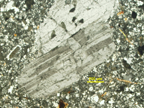
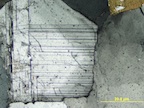
Plagioclase exhibits rather distinctive twinning under cross-polars.
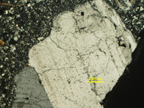
This rollover shows the lack of pleochroism in plagioclase.
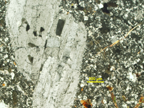
This rollover shows the extinction in plagioclase. The twinning makes for different extinction angles depending on the angle of the crystal, but favors inclined extinction.
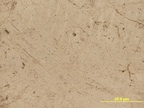
This rollover image shows the contrasting visibility of Plagioclase when viewed under plain polarized light versus crossed polars (second image).
Plagioclase.Extinction.Thumbnail This rollover demonstrates the inclined extinction of Plagioclase as the microscope stage is rotated approximately 45º. The characteristic twinning of Plagioclase is also visible

تالک

Talc
Property
Value
Comments
Formula Mg3Si4O10(OH)2 Very little solid solution.
Crystal System Monoclinic Beta = 100°
Crystal Habit Massive, fine-grained; tabular books .
Cleavage (001) perfect .
Color/Pleochroism Colorless in thin section .
Optic Sign Biaxial (-) .
2V 0-30° .
Optic Orientation Y=b 
Z~a 
X^c ~10o
O.A.P. perp (010)
.
Refractive Indices
alpha = 
beta = 
gamma = 
delta = 

1.539-1.550 
1.589-1.594 
1.589-1.596 
0.050-0.046
.
Max Birefringence 0.05 Beyond 2nd order blue
Elongation Not prismatic  
Extinction Can be parallel  
Dispersion r > v .
Distinguishing Features Muscovite(35-50), paragonite(40-50), and pyrophyllite (53-62) have larger 2V's. 
Brucite and gibbsite are (+).
Occurrence With calcite and tremolite in low-grade marbles. 
With chlorite or magnesite in blackwall reaction zones around serpentinite bodies.
Editors John Brady (00)

 
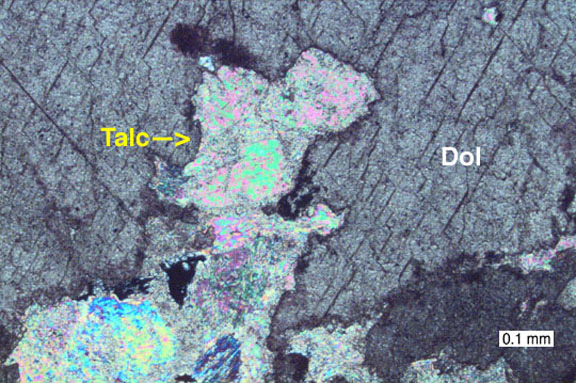
Photomicrograph in crossed polarized light of polycrystalline talc replacing dolomite. The talc appears to be replacing dolomite along fractures as well as along its edges. The talc close to the dolomite tends to be more fine-grained. This sample is from the Sweetwater View Mine, Ruby Range, SW Montana.
Thin section of massive fine-grained talc replacing coarse dolomite in crossed polarized light. The talc is brightly colored (1st to 2nd order colors). The dolomite appears in the washed-out beige characteristic of the high birefringence of carbonates. (Field of view is 5 mm.)

بیوتیت

Biotite
Property
Value
Comments
Formula K(Mg,Fe)3AlSi3O10(OH,O,F)2

Shows substantial variability in composition that can be represented with the four end members:

Annite= KFe3AlSi3O10(OH)2

Phlogopite= KMg3AlSi3O10(OH)2

Siderophyllite KFe2AL(Al2Si2O10)(OH)2

Unnamed end member (formerly known as eastonite)= KMg2Al(Al2Si2O10)(OH)2

The variation in biotite usually occurs in what elements occupy the octahedral sites. However, variations can also occur in what elements are found in the tetrahedral and hydroxyl sites. Examples of these are siderophyllite, oxybiotite, and ferriannite.

Crystal System Monoclinic (2/m) Beta = 99.3o
Crystal Habit Pseudo-hexagonal prisms or lamellar plates without crystal outline. Micaceous or tabular grains, also irregular grains that may be bent (especially in metamorphic rocks). Thin folia are elastic.
Physical Properties

H = 2.5 - 3
G = 2.7 - 3.3

The color of biotite in hand sample is brown to black (sometimes greenish). Its streak is white or gray, and it has a vitreous luster.

The physical properties of biotite are affected by the amount of iron present. The specific gravity (G) is greater with increasing iron content, while the color in hand sample is darker with an increase in iron.
Cleavage (001) perfect Easily seen in thin section
Color/Pleochroism Typically brown, brownish green or reddish brown Usually strongly pleochroic so grains are darker when the trace of cleavage is parallel to the lower polarizer. Colors are X = colorless, light tan, pale greenish brown, pale green; Y~Z = brown, olive brown, dark green, dark red-brown. Intensity of color generally increases with increase in iron content.  Parallel to (001) yields darker colors with little pleochroism. Pleochroic halos around radioactive minerals (zircon or allanite) are common.
Optic Sign Biaxial (-) Some biotite may have a 2V of 0o, is sensibly uniaxial.
2V 0-25o  
Twinning

None

Twins with 001 composition planes are possible, but usually not observed
Optic Orientation Y=b 
Z^a = 0 - 9o
X^c = 0 - 9o
optic plane (010)
 
Refractive Indices
alpha = 
beta = 
gamma = 

1.522-1.625 
1.548-1.672
1.549-1.696 
Refractive indices increase with increasing iron content. The diversity in biotite's composition makes it hard to use optical properties as an indicator for composition. Ferriannite may have alpha and gamma indices as high as 1.677 and 1.721 respectively.
Max Birefringence 0.03-0.07 Strong mineral color will often mask the interference colors (3rd to 4th order). Flakes on the cleavage and sections that are cut parallel with {001}show low birefringence.
Elongation Yes  Along cleavage
Extinction  Parallel or close to parallel Has a "birds eye" texture seen at extinction. Bent grains show wavy extinction.
Dispersion v > r (weak) Less commonly, r > v for Mg rich varieties.
Distinguishing Features Resembles muscovite but has smaller 2V and darker color. Mottled "birds-eye" extinction helps distinguish from similar minerals outside the mica family.  Has moderate to high relief in thin section. Has micaceous habit and dark color.
Occurrence Biotite is common in a variety of igneous and metamorphic rocks. In igneous rocks, it is found more commonly in silicic and alkalic rocks, e.g. granties, diorites, gabbros and peridotites. It is important in metamorphic rocks including schists, gneisses, phyllites, and hornfels.  Also found in immature sedimentary rocks, but will alter to clay minerals when weathered.
Editors Mary Hawkins (01J), Raycine Hodo (02J), Lisa Berrios (02), Jennifer Fitzsimmons (03), Rachel Grandpre (05), Lily Seidman (11), Ngozika Onuzo (12)

 
First In plain polarized light, biotite displays perfect cleavage in one direction. The maximum absorption color is shown when the polarizer is parallel to the cleavage. Under crossed polars biotite displays a distinctive mottled texture as it nears extinction. In extinction position small spots fail to extinguish. These traits are charicteristic of birdseye extinction which is common in micas.
Second

In plane polarized light, biotite is seen as as dark brown to grey against the surrounding mostly colorless minerals. Under crossed polars "bird's eye extinction" can easily be seen when the mineral is nearly extinct. Often, the mineral color masks the interference colors when the mineral is not extinct.

Third
In plain light, biotite in a granite appears a slightly drab brown. Radiation damage from zircon can leave pleochroic spots that fade to extinction at a different rate that the surrounding, undamaged material. There are several small opaque grains as well. Under polarized light biotite appears green with pink undertones. It is surrounded by quartz and feldspars.

Fourth

This is an image of a thin section containing biotite. It is seen now in plane polarized light as a brown to tan color. Under cross-polarized light, the biotite thin section appears darker brown in areas as well as a pink-yellow color in others.

Biotite, usually dark green, brown, or black, has a pale brown color under plane-polarized light in this sample. It exhibits high interference colors in cross-polar light just as muscovite, but has a lower birefringence than muscovite.
Biotite shows parallel extinction in cross polarized light, and has perfect cleavage in one direction. The biotite mineral shown here is exhibits bird's eye texture during extinction, and the mineral is surrounded by quartz, muscovite, and feldspars

موسکوویت

Muscovite
Property
Value
Comments
Formula KAl2(AlSi3O10)(OH)2 Solid solution mineral; substitutions can occur for K, [VI]Al, (OH) and in tetrahedral sites.
Crystal System Monoclinic (2/m) TOT + c crystal structure
Crystal Habit Well formed crystals are tabular and have pseudohexagonal outlines. More often found as micaceous flakes or tablets with irregular outlines. Well-formed crystals are sometimes called "books" in reference to their flaky nature.
Cleavage {001} perfect Well displayed, controls fragment orientation.
Color/Pleochroism Colorless or shades of light green, red, or brown in hand sample; colorless in thin section. No pleochroism.  
Optic Sign Biaxial (-) Muscovite is length slow
2V 28-47o  
Optic Orientation Z=b 
X^c = +1o to +4o
Y^a = +1o to +3o
O.A.P. perp to (010)
 
Refractive Indices
alpha = 
beta = 
gamma = 

1.552-1.576 
1.582-1.615 
1.587-1.618 
 
Birefringence  0.036-0.049 (high) 3rd order, vivid colors of 2nd order
Elongation  yes  
Extinction Parallel to cleavage in all orientations, BIRD'S EYE The maximum extinction angle is less than 3 degrees 
Dispersion    
Distinguishing Features Biotite (darker in color and is pleochroic in ppl), Talc (smaller 2V), Pyrophyllite (larger 2V), birds-eye extinction and cleavage are also distinctive.
Occurrence

Muscovite has a widespread occurance and is characteristic of sedimentary, igneous and metamorphic rocks.

Sediments eroded from igneous and metamorphic rocks often carry muscovite, accounting for its presence in sedimentary rocks.

Igneous occurances include granite, grandorite, aplite, pegmatite and related felsic rocks. is common in granites and granitic pegmatites.

Muscovite is very common in large variety of metamorphic rocks including slate, schist, phyllite, gneiss, hornfels and quartzite.

Editors Priscilla Delano ('02), Sarah Clifthorne ('02), Marit Gamberg ('01), Jenny McNicholas ('11), Kathryn Durkin ('12), Theo Sweezy ('14)

 
This picture of Muscovite shows the characteristic small cleavage lines as well as the differences between Muscovite and Biotite. In crossed polarized light, the Muscovite shows the bright 2nd order colors against the darker feldspar crystal beside it. Click on the thumbnail for a larger, rollover version.
This picture of Muscovite shows the characteristic bird's eye extinction.  The bright 2nd order colors also contrast against the darker feldspar crystal beside it
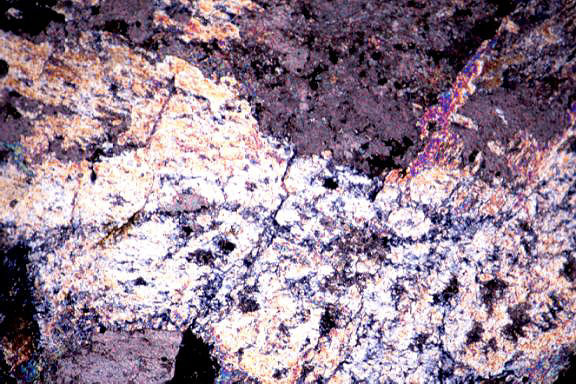
Photomicrograph of muscovite showing 2nd and 3rd order interference colors.

Rollover image showing muscovite from sample W-11 as length slow.

This property is observed when the stage is rotated until the crystal is exinct. The stage is then rotated another 45 degrees so the crystal is lying NE-SW and the gypsum plate is inserted. If the interference colors compound the sample is length slow, if they subtract the sample is length fast.

Muscovite sample W-12 in cross-polarized light.

Click the thumbnail to see a rollover image of the bird's eye texture when the crystal is close to extinction. Bird's eye texture could be be due to damage during slide preperation, but it is also one method of identifying muscovite under the microscope.

A muscovite crystal from sample W-12 in cross-polarized light. Note the bird's eye texture and feather-like lines running across it. The feather-like lines could be due to deformation and is often seen in muscovite crystals found in granite such as this one.

The c-axis of this crystal is nearly vertical. Click the thumbnail to view a rollover of the interference figure.

DR-4Rollover1

Muscovite from sample DR-4 in plane polarized light. Click on the thumbnail to see a rollover image in cross-polars.

PE-19 Muscovite in thin section from sample PE-19. The green muscovite in the center of the image displays twinning, as does the piece to its left. Click to see a rollover image that shows the twinning as the thin section is rotated and gives a better view of the "birds-eye" extinction.
Another view of PE-19 showing textures at extinction.

تورمالین

Tourmaline
Property
Value
Comments
Formula Na(Mg,Fe,Li,Al) 3 Al 6 [Si 6 O 18 ](BO 3 ) 3 (O,OH,F) 4  
Crystal System Hexagonal (trigonal)  
Crystal Habit striated hexagonal prisms  
Cleavage {110} and {101} very poor cleavages
Color/Pleochroism blue, red, green, yellow, black, brown. (Schorl the most common tourmaline is black) strongly pleochroic
Optic Sign Uniaxial (-)  
2V 10 degrees only occasionaly biaxial
Refractive Indices
omega =
  epsilon =

1.631-1.698 
1.610-1.675
 
Max Birefringence 0.035 cannot be used as a reliable guide to composition
Extinction Longitudial sections show parallel extinction and are length fast.  
Unit Cell

a = 15.8-16.0 Angstroms
c = 7.1-7.25 Angstroms
Z = 3

 
Physical Properties
H = 7
G = 2.90-3.22
 
Distinguishing Features

In hand sample: columnar crystals with rounded triangular cross sections.

Poor cleavage

Deep color often masks interference colors

Occurrence Tourmaline is a characteristic mineral in granitic pegmatites. It is an accessory mineral in granite, granodiorite, and related felsic rocks. Tourmaline is also a common mineral in schist, gneiss, quartzite, and phyllite. Also found in metasomatically altered limestone and dolomite in contact metamorphic zones.
Editors Emma Anderson (2005). Data sources: Minerals in Thin Section Perkins, Dexter and Henke, Kevin 2000. Introduction to Opticial Mineralogy Nesse, William 1991. Introduction to Mineralogy Nesse, William 2000.

 
Plane polarized image of tourmaline, which is the small green grain in the center of the image. Note the concentric zoning of colors. Also visible are biotite (tan), muscovite (colorless), quartz, and plagioclase. Click on the image to see a larger version with rollover to crossed polarized light.
Crossed polarized image of tourmaline

ولاستونیت

Wollastonite
Property
Value
Comments
Formula CaSiO3 Pyroxenoid group. Usually pure, but Mn and Fe2+ can substitute for Ca.
Crystal System Triclinic  
Crystal Habit Columnar and fibrous elongate grains, often with twinning  
Cleavage Perfect cleavage on {100}, good cleavages on {001} and {-102} Splitery cleavage fragments. Angles of cleavage: 84.5 degrees, and 70 degrees.
Color/Pleochroism Colorless, white, greyish, often with yellowish or brownish tint. Vitreous. No pleochroism  
Optic Sign Biaxial (-)  
2V 36-60 degrees

Most wollastonite has a 2V of ~40º. This can be higher for Fe-bearing samples.

Optic Orientation X^c = -30 to -44 degrees
Y^b ~ 0 degrees
z^a = +35 to +49 degrees
O.A.P. ~ (010)
Cleavage fragments are length slow or length fast depending on orientation due to Y being parallel to fiber lenght

Refractive Indices

alpha: 1.616-1.645
beta: 1.628-1.652
gamma: 1.631-1.656
delta: 0.013-0.017

Increase with Fe and Mn content.
Max Birefringence 0.013-0.017 Wollastonite resembles tremolite and pectolite, but both have a higher birefringence.
Elongation Grains elongate parallel to b  
Extinction Parallel   Elongate crystals display parallel extinction.
Dispersion    
Distinguishing Features Colorless to grey in thin sectionwith moderate to moderatly high relief. First order interference color yellow-orange. One perfect cleavage and two good cleavages producing splintery cleavage fragments. H = 4.5-5. G = 2.86-3.09. Streak is colorless or white. 
Occurrence Occurs commonly as a product of contact and/or regional metamorphism in limestone and dolomite. Associated minerals include calcite, and grossular in hornfels, tremolite, epidote group members, diopside, and other Ca-Mg silicates.
Editors Sarah Martell AC '06 , Carolyn Tewksbury '07

 
Photomicrograph of wollastonite in plane and crossed polarized light (roll over image). Wollastonite has parallel extinction and has two good cleavages that intersect at an angle of 84º.
Photomicrograph of wollastonite in plane light (roll over image). Wollastonite typically has no color, and has distinct splintery cleavage in an end view. Mag. 10x.

فورستریت

Forsterite
Property
Value
Comments
Formula Mg2SiO4 Mg endmember of olivine (Mg,Fe)2SiO4.
Crystal System orthorhombic 2/m2/m2/m
Crystal Habit  granular masses or rounded, embedded grains  
Cleavage no distinct cleavage conchoidal fracture, brittle
Color/Pleochroism Pale, yellow-green to olive-green. Colorless to pale green in thin section.  Weak, pale green pleochroism in thin section. Darker with increasing Fe, moving away from pure forsterite.  
Optic Sign Biaxial (+)   
2V 82-90

Varies depending on composition.

Optic Orientation X=b 
Y=c 
Z=a
O.A.P. = (010)
 

Refractive Indices
alpha = 
beta = 
gamma = 

1.62-1.64
1.64-1.66
1.66-1.68

 
Extinction parallel   Elongate crystals display parallel extinction.
Distinguishing Features Colorless to olive green in thin section. Second-order interference colors. High relief. Lack of cleavage. H= 6.5-7. G = 3.2. Streak is colorless or white. May be confused with epidote, which has cleavage and a is pistachio-green in hand sample.
Occurrence Occurs in a wide variety of volcanic rocks, both as phenocrysts and as groundmass. Occasionally found in metamorphosed carbonate-bearing rocks (crystalline dolomitic limestones) associated with calcite, dolomite, diopsite, epidote-group minerals, grossular garnet, tremolite, and related Ca-Mg-bearing minerals.
Editors Micehelle Arsenault (01), Jamie Mitchell (03), Angelie Peterson (02), Cheryl Mawaka (04), Stephanie Moore (07)

 
Photomicrograph of forsterite in plane light. Forsterite may display pale yellow pleochroism and no distinct cleavage. This sample has been partially altered to serpentine in the marble. Select image and roll cursor over to view in crossed polarized light.
Photomicrograph of forsterite in a calcite marble under crossed polarized light.  This sample shows second order interference colors.  The forsterite interference color is 2nd order pink. Diopside grains are also visible.

روتیل

Rutile
Property
Value
Comments
Formula

TiO2

Commonly pure TiO2 ; Subsitution for Ti may include Fe, Ta, Sn, Nb ; possible presence of Cr and V

Crystal System Tetrahedral  
Crystal Habit Prisms, Contact Twins (elbow or cyclic-shaped){101} "needle-like" cyrstals in thin section
Birefringence 0.29

Extreme/distinct but often masked by rich mineral color ; intense birefringence makes determining sign of elongation impractical

Cleavage {110} and{010} Barely visible in thin section

Optic Sign

Uniaxial (+)

Hardness 6-6.5
Specific Gravity 4.23-5.5
Color/Pleochroism

Reddish-Brown; Yellow-Brown; interference figures can have numerous isochromes; weak pleochroism (Omega > Epsilon)

Refractive Index
 

Omega: 2.605-2.613
Epsilon: 2.899-2.901

 
Distinguishing Features Extreme positive relief in thin section; rich yellowish-reddish brown color in thin section
Occurrence Very stable in weathering envirnments, common in clastic sediments; Fine fibers found as inclusions in quartz; Large crystals found in Pegmatites; Placer deposits for Titanium
Editors Hillary Friedman ('08)


Photomicrograph of anahedral grains in plane polarized light. From a Blue Shist, Cyros, Greese. (JBB-99-15E)

Click on the thumbnail to see a larger ppl/xpl rollover image.

بیوتیت

Biotite
Property
Value
Comments
Formula K(Mg,Fe)3AlSi3O10(OH,O,F)2

Shows substantial variability in composition that can be represented with the four end members:

Annite= KFe3AlSi3O10(OH)2

Phlogopite= KMg3AlSi3O10(OH)2

Siderophyllite KFe2AL(Al2Si2O10)(OH)2

Unnamed end member (formerly known as eastonite)= KMg2Al(Al2Si2O10)(OH)2

The variation in biotite usually occurs in what elements occupy the octahedral sites. However, variations can also occur in what elements are found in the tetrahedral and hydroxyl sites. Examples of these are siderophyllite, oxybiotite, and ferriannite.

Crystal System Monoclinic (2/m) Beta = 99.3o
Crystal Habit Pseudo-hexagonal prisms or lamellar plates without crystal outline. Micaceous or tabular grains, also irregular grains that may be bent (especially in metamorphic rocks). Thin folia are elastic.
Physical Properties

H = 2.5 - 3
G = 2.7 - 3.3

The color of biotite in hand sample is brown to black (sometimes greenish). Its streak is white or gray, and it has a vitreous luster.

The physical properties of biotite are affected by the amount of iron present. The specific gravity (G) is greater with increasing iron content, while the color in hand sample is darker with an increase in iron.
Cleavage (001) perfect Easily seen in thin section
Color/Pleochroism Typically brown, brownish green or reddish brown Usually strongly pleochroic so grains are darker when the trace of cleavage is parallel to the lower polarizer. Colors are X = colorless, light tan, pale greenish brown, pale green; Y~Z = brown, olive brown, dark green, dark red-brown. Intensity of color generally increases with increase in iron content.  Parallel to (001) yields darker colors with little pleochroism. Pleochroic halos around radioactive minerals (zircon or allanite) are common.
Optic Sign Biaxial (-) Some biotite may have a 2V of 0o, is sensibly uniaxial.
2V 0-25o  
Twinning

None

Twins with 001 composition planes are possible, but usually not observed
Optic Orientation Y=b 
Z^a = 0 - 9o
X^c = 0 - 9o
optic plane (010)
 
Refractive Indices
alpha = 
beta = 
gamma = 

1.522-1.625 
1.548-1.672
1.549-1.696 
Refractive indices increase with increasing iron content. The diversity in biotite's composition makes it hard to use optical properties as an indicator for composition. Ferriannite may have alpha and gamma indices as high as 1.677 and 1.721 respectively.
Max Birefringence 0.03-0.07 Strong mineral color will often mask the interference colors (3rd to 4th order). Flakes on the cleavage and sections that are cut parallel with {001}show low birefringence.
Elongation Yes  Along cleavage
Extinction  Parallel or close to parallel Has a "birds eye" texture seen at extinction. Bent grains show wavy extinction.
Dispersion v > r (weak) Less commonly, r > v for Mg rich varieties.
Distinguishing Features Resembles muscovite but has smaller 2V and darker color. Mottled "birds-eye" extinction helps distinguish from similar minerals outside the mica family.  Has moderate to high relief in thin section. Has micaceous habit and dark color.
Occurrence Biotite is common in a variety of igneous and metamorphic rocks. In igneous rocks, it is found more commonly in silicic and alkalic rocks, e.g. granties, diorites, gabbros and peridotites. It is important in metamorphic rocks including schists, gneisses, phyllites, and hornfels.  Also found in immature sedimentary rocks, but will alter to clay minerals when weathered.
Editors Mary Hawkins (01J), Raycine Hodo (02J), Lisa Berrios (02), Jennifer Fitzsimmons (03), Rachel Grandpre (05), Lily Seidman (11), Ngozika Onuzo (12)
First In plain polarized light, biotite displays perfect cleavage in one direction. The maximum absorption color is shown when the polarizer is parallel to the cleavage. Under crossed polars biotite displays a distinctive mottled texture as it nears extinction. In extinction position small spots fail to extinguish. These traits are charicteristic of birdseye extinction which is common in micas.
Second

In plane polarized light, biotite is seen as as dark brown to grey against the surrounding mostly colorless minerals. Under crossed polars "bird's eye extinction" can easily be seen when the mineral is nearly extinct. Often, the mineral color masks the interference colors when the mineral is not extinct.

Third
In plain light, biotite in a granite appears a slightly drab brown. Radiation damage from zircon can leave pleochroic spots that fade to extinction at a different rate that the surrounding, undamaged material. There are several small opaque grains as well. Under polarized light biotite appears green with pink undertones. It is surrounded by quartz and feldspars.

Fourth

This is an image of a thin section containing biotite. It is seen now in plane polarized light as a brown to tan color. Under cross-polarized light, the biotite thin section appears darker brown in areas as well as a pink-yellow color in others.

Biotite, usually dark green, brown, or black, has a pale brown color under plane-polarized light in this sample. It exhibits high interference colors in cross-polar light just as muscovite, but has a lower birefringence than muscovite.
Biotite shows parallel extinction in cross polarized light, and has perfect cleavage in one direction. The biotite mineral shown here is exhibits bird's eye texture during extinction, and the mineral is surrounded by quartz, muscovite, and feldspars.

گارنت امفیبول

گارنت میکا شیست

Quartz
Quartz
Diopside
Diopside
 
Native GoldPyromorphite

Starting Your Own Mineral Collection

You probably have a few rocks or minerals already – interesting things you picked up on a family vacation, or a class field trip. The first thing to do is identify what you already have.  Once you’ve figured out what you have, you can call them specimens (rather than just a bunch of pretty cool rocks). Keep the ones you like the best, or that interest you the most, and get rid of the others (your garden is a good place to discard them). The next thing to do is decide what kind of collection you want, based on what you already have, or what you’d like to start collecting. If you don’t have any rocks or minerals already, this is where you start.


Pyromorphite

Types of minerals:

There are many kinds of minerals, and they may not all interest you. Here’s a short list of the most common minerals and some of their varieties:

Quartz (Tiger Eye, Chert, Agate, Amethyst, Rose Quartz, Citrine)

Plagioclase Feldspar (Albite, Labradorite)

Potassium Feldspar (Microcline)

Calcite (Dog’s Tooth, Optical Calcite)

Gypsum (Satin Spar, Desert Rose, Selenite)

Fluorite

Halite

Garnet (Pyrope, Almandine, Grossular)

Mica (Muscovite, Biotite, Lepidolite)

Hematite

Pyrite

Magnetite

Olivine

Serpentine

Hornblende

ماشین های توپ

t4587_.jpg

s4968_.jpgs35_.jpg


a5632_.jpg

g6467_.jpg

j323_.jpg

فونت زیبا ساز

من پذيرفتم که عشق افسانه است ... اين دل درد آشنا ديوانه است

مي روم شايد فراموشت کنم ... با فراموشي هم آغوشت کنم

مي روم از رفتن من شاد باش ... از عذاب ديدنم آزادباش

گر چه تو تنها تر از ما مي روي ... آرزو دارم ولي عاشق شوي

آرزو دارم بفهمي درد را ... تلخي بر خوردهاي سرد

فونت زيبا سازفونت زيبا سازفونت زيبا سازفونت زيبا سازفونت زيبا ساز

 تصاوير جديد زيباسازی وبلاگ , سايت پيچك » بخش تصاوير زيباسازی » سری ششم www.pichak.net كليك كنيد

طرز تهیه موفقیت

مواد لازم:

١- یك عدد هدف

٢- یك فنجان باور مثبت

٣- نصف لیوان مغز (خواهشا سالم!)

٤- یك قاشق میوه خوری شعور

٥- توكل (هر چه بیشتر بهتر)

٦- سر سوزن تلاش

٧- علاقه و انگیزه به میزان لازم

طرز تهیه:

ابتدا شماره ی ١ را شماره ی ٢ با حرارت ملایم خوب بپزید. سپس به آن

شماره ی ٤ را اضافه كنید و خوب هم بزنید.

آشپزهای عزیز دقت كنید كه اگر حرارت شما زیاد باشد اهدافتان ذغال می شود!

بعد از اینكه عملیات پخت كامل شد هدف را مقابل خودتان

قرار دهید و به آن خیره شوید.

با استفاده از شماره ی ٣ آن را دست یافتنی و نزدیک تصور کنید.

سپس با شماره ی ۷ به طرف آن حرکت کنید

 و «از موانع سر رهتان٬ پلکان صعود بسازد.»


 شماره ی ۶ را به طور مستمر بکار ببندید

 و در طول راه با نگاه هایی مملو از شماره ی ۲ نظاره گر موفقیت باشید.

راستی! یادمون نره٬ شماره ی ۵ بهترین طعم دهنده ی این نوع غذاهاست

 که اگه نباشه غذامون خورده نمیشه

لرهای عزیز توجه کنید::::::؟.......؟.؟؟""""

گزارش و عکس های ایبنانیوز از کاراکتر موهن گرگعلی در شبکه جام جم

کانال 1 شبکه برون مرزی صداوسیمای جمهوری اسلامی (جام جم 1)، در یک کج سلیقگی آشکار به تحقیر و تمسخر ویژگی های فرهنگی اقوام ایرانی لر بختیاری پرداخت. در این برنامه که ظاهراً به مناسبت دهه فجر 1390 بر روی آنتن رفت، روح دهه فجر یعنی «برادری آحاد جامعه ایران در سایه تعالیم اسلام» نقض شد و کاراکتری به نام «گرگعلی» که خود را اهل چهارمحال و بختیاری معرفی کرد، پس از چند دقیقه نمایش لودگی و حرکات مضحک، پوشش محلی لری (شلوار دبیت) خود را برغم ابراز مخالفت و رویگردانی مجری، از پا درآورد و بینندگان با کمال تعجب مشاهده کردند که «گرگعلی» زیر لباس لری خود لباس عربی (دشداشه سفید) پوشیده است!


پلاژیوکلازها

Plagioclase exhibits rather distinctive twinning under cross-polars.
This rollover shows the lack of pleochroism in plagioclase.
This rollover shows the extinction in plagioclase. The twinning makes for different extinction angles depending on the angle of the crystal, but favors inclined extinction.
This rollover image shows the contrasting visibility of Plagioclase when viewed under plain polarized light versus crossed polars (second image).
Plagioclase.Extinction.Thumbnail This rollover demonstrates the inclined extinction of Plagioclase as the microscope stage is rotated approximately 45º. The characteristic twinning of Plagioclase is also visible.
  Further Images of Plagioclase, From UCLA

ارتو پیروکسن


Photomicrograph of orthopyroxene (low birefringence, skinny lamellae) surrounded by clinopyroxene (higer birefringence, coarse lamellae).  Sample SIC-3.  Large photo is1.7 mm wide. Image by Elizabeth Thomas.

Orthopyroxene -  Volcanic, sample JP-17. Image by Elizabeth Thomas.

Orthopyroxene - Sample SIC-3. Image by Elizabeth Thomas.
Orthopyroxene - Sample SIC - 4. First order greys and thin lamellae. Image by Andrea Gohl.
Orthopyroxene - Sample SIC - 3. Orthopyroxene with high relief and thin irregular lamellae. Image by Andrea Gohl.
Orthopyroxene - Sample SIC -5. Orthopyroxene seen in the center. Note plagioclase (left of orthopyroxene) with typical twinning. Image by Andrea Gohl.
WWW Images

1-فلدسپات
1-فلدسپات پريدوتيت
 
2-فلدسپات
2-فلدسپات پريدوتيت
 
3-سرپانتينيت
3-سرپانتينيت (سرپانتين بصورت رشته هاي ظريف)
 
4-سرپانتينيت
4-سرپانتينيت
2-روتيل
2-روتيل در يك كورديريت-ژدريت گنيس
 
3-آنتيگوريت
3-آنتيگوريت در سنگ صابون
 
4-آنتيگوريت
4-آنتيگوريت در سنگ صابون(هارزبورژيت دگرگون شده)
 
5-تالك
5-تالك در سنگ صابون(هارزبورژيت دگرگون شده)
 
6-تالك
6-تالك در سنگ صابون(هارزبورژيت دگرگون شده)
 
7-استاروليت
7-استاروليت در يك موسكويت-بيوتيت شيست
 
5-پريدوتيت(لرزوليت)
5-پريدوتيت(لرزوليت)
 
6-پريدوتيت
6-پريدوتيت
Photomicrograph of quartz under plane polarized light.
Photomicrographic image of Quartz under cross polarized light. The rollover image shows the wave type of extinction that is common in Quartz.
str

Photomicrographic image of quartz under crossed polarized light. The rollover displays the same grain under plain polarized light. Poor cleavage is visible in both images. Note the low relief seen under plain polarized light.

ex

Undulatory extinction is a common feature of quartz. The rollover image displays the same grain with rotation. Notice, the entire grain never goes completely extinct at once.

گابرو لایه ای

گابرو لایه ای از افیولیت کرمانشاه (شمال غرب نورآباد)

Layered gabbro from Kermanshah ophiolite

http://www.pic.iran-forum.ir/images/hgzguy27abqxjac1gccm.jpg

http://www.pic.iran-forum.ir/images/y3lgsw29zsrfchpc1e4k.jpg

بزرگترین معدن طلای جهان

معدن کارسبرگ  بزرگترین معدن طلای جهان در پاپوآ

 در کشور اندونزی قرار دارد که سومین معدن بزرگ مس نیز می باشد.


http://akrockefeller.com/wp-content/uploads/2010/09/grasberg-1.jpg

http://upload.wikimedia.org/wikipedia/commons/0/05/Grasberg_mine.jpg

رنگین کمان آتشین

جدیدترین عکس های مریم اسدیمریم اسدی / Maryam Asadiمریم اسدیمریم اسدی

گلشیفته فراهانی


مریم کاویانیمریم اسدی

جمله های غمگین


متن آهنگ تصور کن


یه بار دیگه بیایم با هم خیال پردازی کنیم اونم از نوع مثبتش ! چه اشکالی داره؟مگه آرزو بر جوانان عیبه؟


ترانه :  تصور كن


» آلبوم :  روزهای بی خاطره

» خواننده :  سیاوش قمیشی

» ترانه سرا :  يغما گلروئی

» آهنگساز :  سیاوش قمیشی


تصور کن اگه حتی تصور کردنش سخته!


جهانی که هر انسانی تو اون خوشبخته خوشبخته!


جهانی که تو اون پول و نژاد و قدرت ارزش نیست!


جواب هم‌صدایی‌ها پلیس زِد شورش نیست!


نه بمب هسته‌ای داره، و نه بمب‌افکن نه خمپاره!


دیگه هیچ بچه‌ای پاشو روی مین جا نمی‌زاره!


همه آزاده آزادن، همه بی‌درد بی‌دردن!


تو روزنامه نمی‌خونی، نهنگا خودکشی کردن!


جهانی را تصور کن، بدون نفرت و باروت!

بدون ظلم خود کامه، بدون وحشت و تابوت!

جهانی را تصور کن، پر از لبخند و آزادی!

لبالب از گل و بوسه، پر از تکرار آبادی!


تصور کن اگه حتی تصور کردنش جرمه!

اگه با بردن اسمش گلوت پر میشه پر از سرمه!

تصور کن جهانی را که توش زندانی افسانه‌س!

تمام جنگ‌های دنیا، شدن مشمول آتش‌بس!

کسی آقای عالم نیست، برابر با هم‌اند مردم!

دیگه سهم هر انسانِ تن هر دونه‌ی گندم!

بدون مرزو محدوده، وطن یعنی همه دنیا!

اگر دنیا دست زنها بیفتد چه میشود؟

اگر دنيا دست دخترها بيفتد ال مي شود يا بل مي‌شود؟


يک روزنامه نگار سيبيل کلفت مي گويد: اوا! خدا آن روز را نياورد مگر از جان و مال و ناموس و زندگي‌مان گذشته‌ايم؟


يک متخصص فناوري‌هاي نوين مي‌گويد: همه‌مون را مي‌ذارن سينه ديوار، نفري يه گلوله خرجمون مي‌کنند به چه قشنگي! بعدش هم مي‌گن حيف همون يه گلوله!


يک کارشناس ارشد غذاهاي دريايي عقيده دارد: روزي که دنيا بيفتد دست اين ضعيفه‌ها، ارکان نظام‌هاي دموکراتيک مرد مدار، به لرزه مي‌افتد. روز اول مردها را کنج خانه‌ها به امر خطير «بشور و بساب» مي‌گمارند، خودشان به خيابان‌ها مي آيند يک رفراندوم راه مي‌اندازند که تنها زن‌ها در آن حق راي دارند. بعد نتيجه شمارش آرا با نظارت شوراهاي يک روزه اين مي‌شود که ۹/۹۹ درصد راي دهندگان به خروج آقايان از حاکميت راي مي دهند!


آن يک دهم درصد را هم براي افه دموکراسي کنار مي‌گذارند.


کامران خان همسايه مامانم اينها ضمن اشاره به انقراض حکومت‌هاي زن سالار در هزاره‌هاي پيشين و مسبوق به سابقه بودن شکست‌هاي مکرر زنان در اداره امور مملکتي فرايند سپردن امور به ضعيفه‌ها را فرآيندي از پيش شکست خورده مي‌داند.


اما خواهر يک کودک فهيم مي‌گويد: آهاي! آقايان! بيچاره همين حالا هم دنيا دست زنان مي‌باشد، (شما توي باغ نمي‌باشيد!)

یک دختر در حموم

ساعت ۴ بعد از ظهر


۱ـ لباساشو رو درمياره٬ رنگ روشن ها رو تو يك سبد و تيره ها رو تو يكي ديگه ميگذاره


۲ـ در حموم رو از تو قفل ميكنه٬ جلوي آيينه مي ايسته٬ شكمش رو كه تمام مدت داده بود تو٬ ميده بيرون و شروع ميكنه به غر غر و ايراد گرفتن از نقطه نقطه بدنش


۳ـ در كمد رو باز ميكنه انواع شامپو و صابون معطر مخصوص پوست صورت٬مو٬ بدن٬ كف پا و ... رو بيرون مياره و مي چينه رو لبه وان


۴ـ موهاش رو با شامپوي نارگيلي تقويت كننده٬ پرپشت كننده٬ براق كننده و...ميشوره و هفده دقيقه ماساژ ميده


۵ـ يكبار ديگه با همون شامپو موهاشو ميشوره


۶ـ نرم كننده معطر پرتقالي رو به موهاش ميماله تا ۶۰ ميشماره


۷ـ سي و پنج دقيقه زير دوش مي مونه.خوب آخه بايد خيالش راحت بشه كه تمام مواد شيميايي از موهاش پاك شده. وگرنه بعد از حموم موها وز ميكنه


۸ـ خمير ريش داداشي رو كش ميره و شيش كيلو خالي ميكنه رو ساق پا و دست و پشت لب. بعد يه تيغ بر ميداره و يا علي. آي


۹ـ موهاش رو حسابي مي چلونه٬ حوله رو مثل عمامه مي پيچه دور سرش. تو آيينه خودشو ورانداز ميكنه. از اينكه در اثر كشش حوله چشم و ابروش كشيده شده٬ احساس خوشگلي مي كنه و يه ماچ گنده واسه عكس خودش تو آيينه ميفرسته


۱۰ـ خوشحاليش زياد دوام نمياره. چون يه جوش سرسياه بي اجازه نوك دماغش سبز شده


۱۱ـ تمام نقاط بدنش رو معاينه ميكنه و با ناخن و موچين ميره به جنگ جوشها و موهاي زائد بي تربيت


۱۲ـ حوله ش رو مي پوشه و ميره به اتاقش.تمام بدنش رو با لوسيون چرب ميكنه


۱۳ـ چهل بار لباس مي پوشه و در مياره تا انتخاب كنه


۱۴ـ ۴۸ دقيقه پشت ميز توالت مي شينه و آرايش ميكنه


ساعت ۸ شب شد !!!

من تنها ترینم