
+ نوشته شده در سه شنبه هفتم آذر ۱۳۹۱ ساعت 13:46 توسط پوریا
|
 Amethyst/Améthyste
Location: Thunder Bay, Ontario, Canada
Source: Royal Ontario Museum/Musée Royal de l'Ontario
Notes: This variety of quartz is the official mineral emblem of Ontario./Cette varieté de quartz est l'emblème minéral de l'Ontario.
Photography: Calvin Nicholls, reproduced courtesy of Nicholls Design, Inc.
 Cubanite crystals/Cristaux de cubanite
 Diopside on grossular/Diopside sur grossulaire
 Gypsum/Gypse
 Lazulite, Quartz and Siderite/Lazulite, quartz et sidérite
 Native gold/Or natif
 Pyrite crystals/Cristaux de pyrite
 Pyromorphite/Pyromorphite
 Pyrrhotite on Calcite/Pyrrhotite sur calcite
 Quartz, variety amethyst - sceptre habit/Quartz sceptre, variété améthyste
 Rhodochrosite (rose) with Aegirine (dark green) and Genthelvite (white)
 Uranophane/Uranophane
|
| ||
|
|
|
|
| Formula | NaAlSi3O8-CaAl2Si2O8 | Solid-solution between sodium-rich end-member (albite) and calcium-rich end-member (anorthite). |
| Crystal System | triclinic | Triclinic shape contributes to interesting optical angles. |
| Crystal Habit | Euhedral or anhedral grains. | |
| Cleavage | Uneven to conchoidal fractures and some cleavages. Brittle. | (001) is a perfect cleavage, and (010) is also quite good. (110) is a very poor cleavage and is not usually seen in thin section. Cleavages intersect at about 93-94 degree angles. The cleavage may not be obvious in thin section; the best examples are often seen along the edge of the slide. |
| Color/Pleochroism | Colorless in thin section | White and grey are common in hand sample; albite tends to be lighter and anorthite darker. Iron inclusions can produce reds. Under cross-polars, first-order colors, mostly gray. Yellow interference colors generally imply a thick section. |
| Optic Sign | Biaxial (+) or (-) | The sign varies, depending on composition. |
| 2V | 45-90 | 2V depends on composition. It is not a reliable indicator of composition, but can help confirm a composition determined by other techniques. Twinning and exsolution lamellae may make it difficult to get a 2V measurement. |
| Optic Orientation | Varies. | Due to the solid solution, changes in the optical orientation can be a good indicator of composition. |
| Refractive Indices alpha = beta = gamma = delta = |
|
Variation is due to composition of the mineral. Greater amounts of anorthite lead to higher refractive indices. |
| Elongation | ||
| Extinction | Inclined. | As this is a triclinic mineral, the indicatrix axes will not line up with the crystal axes on any regular basis, and as a result extinction is almost invariably inclined. |
| Distinguishing Features |
Hardness and cleavage are good indicators of a plagioclase as opposed to other similar silicates. In thin section or grain mount, the general lack of pleochroism and the twinning are good indicators. Can be confused with quartz if there is no twinning, however the optic axis figure will resolve this. Often a grey color in comparison to other feldspars. | |
| Occurrence | One of the most common minerals on Earth. Occurs in nearly all igneous rocks- very common in granites, rhyolites, pegmatites, and similar rocks. Albite tends to be more common than anorthite, with the exception of in metamorphosed carbonates. Also very common in metamorphic rocks, with albite being common in low-grade metamorphic rocks. Also seen in sedimentary detritus. | |
| Editors | Raquel Blonshine ('11), Michelle Cortrite ('13) | |
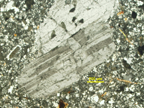 |
Plagioclase exhibits rather distinctive twinning under cross-polars. |
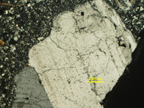 |
This rollover shows the lack of pleochroism in plagioclase. |
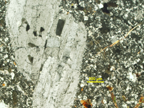 |
This rollover shows the extinction in plagioclase. The twinning makes for different extinction angles depending on the angle of the crystal, but favors inclined extinction. |
 |
This rollover image shows the contrasting visibility of Plagioclase when viewed under plain polarized light versus crossed polars (second image). |
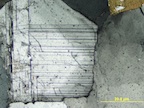 |
This rollover demonstrates the inclined extinction of Plagioclase as the microscope stage is rotated approximately 45º. The characteristic twinning of Plagioclase is also visible |
|
| ||
|
|
|
|
| Formula | Mg3Si4O10(OH)2 | Very little solid solution. |
| Crystal System | Monoclinic | Beta = 100° |
| Crystal Habit | Massive, fine-grained; tabular books | . |
| Cleavage | (001) perfect | . |
| Color/Pleochroism | Colorless in thin section | . |
| Optic Sign | Biaxial (-) | . |
| 2V | 0-30° | . |
| Optic Orientation | Y=b Z~a X^c ~10o O.A.P. perp (010) |
. |
| Refractive Indices alpha = beta = gamma = delta = |
1.539-1.550 1.589-1.594 1.589-1.596 0.050-0.046 |
. |
| Max Birefringence | 0.05 | Beyond 2nd order blue |
| Elongation | Not prismatic | |
| Extinction | Can be parallel | |
| Dispersion | r > v | . |
| Distinguishing Features | Muscovite(35-50), paragonite(40-50), and pyrophyllite (53-62) have larger 2V's. Brucite and gibbsite are (+). | |
| Occurrence | With calcite and tremolite in low-grade marbles. With chlorite or magnesite in blackwall reaction zones around serpentinite bodies. | |
| Editors | John Brady (00) | |
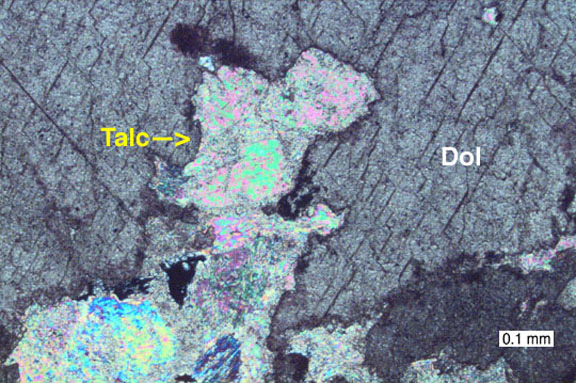 |
Photomicrograph in crossed polarized light of polycrystalline talc replacing dolomite. The talc appears to be replacing dolomite along fractures as well as along its edges. The talc close to the dolomite tends to be more fine-grained. This sample is from the Sweetwater View Mine, Ruby Range, SW Montana. |
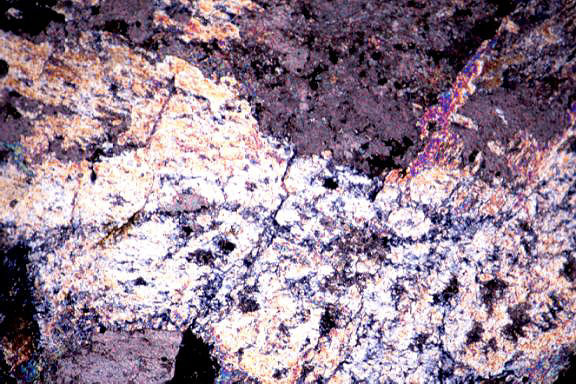 |
Thin section of massive fine-grained talc replacing coarse dolomite in crossed polarized light. The talc is brightly colored (1st to 2nd order colors). The dolomite appears in the washed-out beige characteristic of the high birefringence of carbonates. (Field of view is 5 mm.) |
|
| ||
|
|
|
|
| Formula | K(Mg,Fe)3AlSi3O10(OH,O,F)2 |
Shows substantial variability in composition that can be represented with the four end members: Annite= KFe3AlSi3O10(OH)2 Phlogopite= KMg3AlSi3O10(OH)2 Siderophyllite KFe2AL(Al2Si2O10)(OH)2 Unnamed end member (formerly known as eastonite)= KMg2Al(Al2Si2O10)(OH)2 The variation in biotite usually occurs in what elements occupy the octahedral sites. However, variations can also occur in what elements are found in the tetrahedral and hydroxyl sites. Examples of these are siderophyllite, oxybiotite, and ferriannite. |
| Crystal System | Monoclinic (2/m) | Beta = 99.3o |
| Crystal Habit | Pseudo-hexagonal prisms or lamellar plates without crystal outline. | Micaceous or tabular grains, also irregular grains that may be bent (especially in metamorphic rocks). Thin folia are elastic. |
| Physical Properties |
H = 2.5 - 3 The color of biotite in hand sample is brown to black (sometimes greenish). Its streak is white or gray, and it has a vitreous luster. |
The physical properties of biotite are affected by the amount of iron present. The specific gravity (G) is greater with increasing iron content, while the color in hand sample is darker with an increase in iron. |
| Cleavage | (001) perfect | Easily seen in thin section |
| Color/Pleochroism | Typically brown, brownish green or reddish brown | Usually strongly pleochroic so grains are darker when the trace of cleavage is parallel to the lower polarizer. Colors are X = colorless, light tan, pale greenish brown, pale green; Y~Z = brown, olive brown, dark green, dark red-brown. Intensity of color generally increases with increase in iron content. Parallel to (001) yields darker colors with little pleochroism. Pleochroic halos around radioactive minerals (zircon or allanite) are common. |
| Optic Sign | Biaxial (-) | Some biotite may have a 2V of 0o, is sensibly uniaxial. |
| 2V | 0-25o | |
| Twinning |
None |
Twins with 001 composition planes are possible, but usually not observed |
| Optic Orientation | Y=b Z^a = 0 - 9o X^c = 0 - 9o optic plane (010) |
|
| Refractive Indices alpha = beta = gamma = |
1.522-1.625 1.548-1.672 1.549-1.696 |
Refractive indices increase with increasing iron content. The diversity in biotite's composition makes it hard to use optical properties as an indicator for composition. Ferriannite may have alpha and gamma indices as high as 1.677 and 1.721 respectively. |
| Max Birefringence | 0.03-0.07 | Strong mineral color will often mask the interference colors (3rd to 4th order). Flakes on the cleavage and sections that are cut parallel with {001}show low birefringence. |
| Elongation | Yes | Along cleavage |
| Extinction | Parallel or close to parallel | Has a "birds eye" texture seen at extinction. Bent grains show wavy extinction. |
| Dispersion | v > r (weak) | Less commonly, r > v for Mg rich varieties. |
| Distinguishing Features | Resembles muscovite but has smaller 2V and darker color. Mottled "birds-eye" extinction helps distinguish from similar minerals outside the mica family. Has moderate to high relief in thin section. Has micaceous habit and dark color. | |
| Occurrence | Biotite is common in a variety of igneous and metamorphic rocks. In igneous rocks, it is found more commonly in silicic and alkalic rocks, e.g. granties, diorites, gabbros and peridotites. It is important in metamorphic rocks including schists, gneisses, phyllites, and hornfels. Also found in immature sedimentary rocks, but will alter to clay minerals when weathered. | |
| Editors | Mary Hawkins (01J), Raycine Hodo (02J), Lisa Berrios (02), Jennifer Fitzsimmons (03), Rachel Grandpre (05), Lily Seidman (11), Ngozika Onuzo (12) | |
 |
In plain polarized light, biotite displays perfect cleavage in one direction. The maximum absorption color is shown when the polarizer is parallel to the cleavage. Under crossed polars biotite displays a distinctive mottled texture as it nears extinction. In extinction position small spots fail to extinguish. These traits are charicteristic of birdseye extinction which is common in micas. |
 |
In plane polarized light, biotite is seen as as dark brown to grey against the surrounding mostly colorless minerals. Under crossed polars "bird's eye extinction" can easily be seen when the mineral is nearly extinct. Often, the mineral color masks the interference colors when the mineral is not extinct. |
 |
In plain light, biotite in a granite appears a slightly drab brown. Radiation damage from zircon can leave pleochroic spots that fade to extinction at a different rate that the surrounding, undamaged material. There are several small opaque grains as well. Under polarized light biotite appears green with pink undertones. It is surrounded by quartz and feldspars. |
|
|
This is an image of a thin section containing biotite. It is seen now in plane polarized light as a brown to tan color. Under cross-polarized light, the biotite thin section appears darker brown in areas as well as a pink-yellow color in others. |
 |
Biotite, usually dark green, brown, or black, has a pale brown color under plane-polarized light in this sample. It exhibits high interference colors in cross-polar light just as muscovite, but has a lower birefringence than muscovite. |
 |
Biotite shows parallel extinction in cross polarized light, and has perfect cleavage in one direction. The biotite mineral shown here is exhibits bird's eye texture during extinction, and the mineral is surrounded by quartz, muscovite, and feldspars |
| Muscovite | ||
|
|
Value |
|
| Formula | KAl2(AlSi3O10)(OH)2 | Solid solution mineral; substitutions can occur for K, [VI]Al, (OH) and in tetrahedral sites. |
| Crystal System | Monoclinic (2/m) | TOT + c crystal structure |
| Crystal Habit | Well formed crystals are tabular and have pseudohexagonal outlines. More often found as micaceous flakes or tablets with irregular outlines. | Well-formed crystals are sometimes called "books" in reference to their flaky nature. |
| Cleavage | {001} perfect | Well displayed, controls fragment orientation. |
| Color/Pleochroism | Colorless or shades of light green, red, or brown in hand sample; colorless in thin section. No pleochroism. | |
| Optic Sign | Biaxial (-) | Muscovite is length slow |
| 2V | 28-47o | |
| Optic Orientation | Z=b X^c = +1o to +4o Y^a = +1o to +3o O.A.P. perp to (010) |
|
| Refractive Indices alpha = beta = gamma = |
1.552-1.576 1.582-1.615 1.587-1.618 |
|
| Birefringence | 0.036-0.049 (high) | 3rd order, vivid colors of 2nd order |
| Elongation | yes | |
| Extinction | Parallel to cleavage in all orientations, BIRD'S EYE | The maximum extinction angle is less than 3 degrees |
| Dispersion | ||
| Distinguishing Features | Biotite (darker in color and is pleochroic in ppl), Talc (smaller 2V), Pyrophyllite (larger 2V), birds-eye extinction and cleavage are also distinctive. | |
| Occurrence |
Muscovite has a widespread occurance and is characteristic of sedimentary, igneous and metamorphic rocks. Sediments eroded from igneous and metamorphic rocks often carry muscovite, accounting for its presence in sedimentary rocks. Igneous occurances include granite, grandorite, aplite, pegmatite and related felsic rocks. is common in granites and granitic pegmatites. Muscovite is very common in large variety of metamorphic rocks including slate, schist, phyllite, gneiss, hornfels and quartzite. | |
| Editors | Priscilla Delano ('02), Sarah Clifthorne ('02), Marit Gamberg ('01), Jenny McNicholas ('11), Kathryn Durkin ('12), Theo Sweezy ('14) | |
 |
This picture of Muscovite shows the characteristic small cleavage lines as well as the differences between Muscovite and Biotite. In crossed polarized light, the Muscovite shows the bright 2nd order colors against the darker feldspar crystal beside it. Click on the thumbnail for a larger, rollover version. |
 |
This picture of Muscovite shows the characteristic bird's eye extinction. The bright 2nd order colors also contrast against the darker feldspar crystal beside it |
 |
Photomicrograph of muscovite showing 2nd and 3rd order interference colors. |
 |
Rollover image showing muscovite from sample W-11 as length slow. This property is observed when the stage is rotated until the crystal is exinct. The stage is then rotated another 45 degrees so the crystal is lying NE-SW and the gypsum plate is inserted. If the interference colors compound the sample is length slow, if they subtract the sample is length fast. |
 |
Muscovite sample W-12 in cross-polarized light. Click the thumbnail to see a rollover image of the bird's eye texture when the crystal is close to extinction. Bird's eye texture could be be due to damage during slide preperation, but it is also one method of identifying muscovite under the microscope. |
 |
A muscovite crystal from sample W-12 in cross-polarized light. Note the bird's eye texture and feather-like lines running across it. The feather-like lines could be due to deformation and is often seen in muscovite crystals found in granite such as this one. The c-axis of this crystal is nearly vertical. Click the thumbnail to view a rollover of the interference figure. |
 |
Muscovite from sample DR-4 in plane polarized light. Click on the thumbnail to see a rollover image in cross-polars. |
 |
Muscovite in thin section from sample PE-19. The green muscovite in the center of the image displays twinning, as does the piece to its left. Click to see a rollover image that shows the twinning as the thin section is rotated and gives a better view of the "birds-eye" extinction. |
 |
Another view of PE-19 showing textures at extinction. |
|
Tourmaline | ||
|
|
|
|
| Formula | Na(Mg,Fe,Li,Al) 3 Al 6 [Si 6 O 18 ](BO 3 ) 3 (O,OH,F) 4 | |
| Crystal System | Hexagonal (trigonal) | |
| Crystal Habit | striated hexagonal prisms | |
| Cleavage | {110} and {101} | very poor cleavages |
| Color/Pleochroism | blue, red, green, yellow, black, brown. (Schorl the most common tourmaline is black) | strongly pleochroic |
| Optic Sign | Uniaxial (-) | |
| 2V | 10 degrees | only occasionaly biaxial |
|
Refractive Indices omega = epsilon = |
1.631-1.698 1.610-1.675 |
|
| Max Birefringence | 0.035 | cannot be used as a reliable guide to composition |
| Extinction | Longitudial sections show parallel extinction and are length fast. | |
| Unit Cell |
a = 15.8-16.0 Angstroms |
|
|
Physical Properties |
H = 7 G = 2.90-3.22 |
|
| Distinguishing Features |
In hand sample: columnar crystals with rounded triangular cross sections. Poor cleavage Deep color often masks interference colors | |
| Occurrence | Tourmaline is a characteristic mineral in granitic pegmatites. It is an accessory mineral in granite, granodiorite, and related felsic rocks. Tourmaline is also a common mineral in schist, gneiss, quartzite, and phyllite. Also found in metasomatically altered limestone and dolomite in contact metamorphic zones. | |
| Editors | Emma Anderson (2005). Data sources: Minerals in Thin Section Perkins, Dexter and Henke, Kevin 2000. Introduction to Opticial Mineralogy Nesse, William 1991. Introduction to Mineralogy Nesse, William 2000. | |
 |
Plane polarized image of tourmaline, which is the small green grain in the center of the image. Note the concentric zoning of colors. Also visible are biotite (tan), muscovite (colorless), quartz, and plagioclase. Click on the image to see a larger version with rollover to crossed polarized light. |
 |
Crossed polarized image of tourmaline |
|
| ||
|
|
|
|
| Formula | CaSiO3 | Pyroxenoid group. Usually pure, but Mn and Fe2+ can substitute for Ca. |
| Crystal System | Triclinic | |
| Crystal Habit | Columnar and fibrous elongate grains, often with twinning | |
| Cleavage | Perfect cleavage on {100}, good cleavages on {001} and {-102} | Splitery cleavage fragments. Angles of cleavage: 84.5 degrees, and 70 degrees. |
| Color/Pleochroism | Colorless, white, greyish, often with yellowish or brownish tint. Vitreous. No pleochroism | |
| Optic Sign | Biaxial (-) | |
| 2V | 36-60 degrees |
Most wollastonite has a 2V of ~40º. This can be higher for Fe-bearing samples. |
| Optic Orientation | X^c = -30 to -44 degrees Y^b ~ 0 degrees z^a = +35 to +49 degrees O.A.P. ~ (010) |
Cleavage fragments are length slow or length fast depending on orientation due to Y being parallel to fiber lenght |
|
Refractive Indices |
alpha: 1.616-1.645 |
Increase with Fe and Mn content. |
| Max Birefringence | 0.013-0.017 | Wollastonite resembles tremolite and pectolite, but both have a higher birefringence. |
| Elongation | Grains elongate parallel to b | |
| Extinction | Parallel | Elongate crystals display parallel extinction. |
| Dispersion | ||
| Distinguishing Features | Colorless to grey in thin sectionwith moderate to moderatly high relief. First order interference color yellow-orange. One perfect cleavage and two good cleavages producing splintery cleavage fragments. H = 4.5-5. G = 2.86-3.09. Streak is colorless or white. | |
| Occurrence | Occurs commonly as a product of contact and/or regional metamorphism in limestone and dolomite. Associated minerals include calcite, and grossular in hornfels, tremolite, epidote group members, diopside, and other Ca-Mg silicates. | |
| Editors | Sarah Martell AC '06 , Carolyn Tewksbury '07 | |
 |
Photomicrograph of wollastonite in plane and crossed polarized light (roll over image). Wollastonite has parallel extinction and has two good cleavages that intersect at an angle of 84º. |
 |
Photomicrograph of wollastonite in plane light (roll over image). Wollastonite typically has no color, and has distinct splintery cleavage in an end view. Mag. 10x. |


